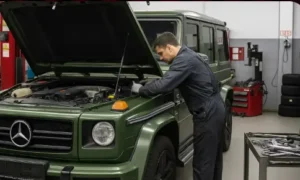


Servicing your car outside the dealer network does not automatically void a car warranty in Dubai or anywhere else in the UAE. What a warranty actually requires is that the car is maintained to the manufacturer’s schedule with suitable parts, and that you can prove it. This guide explains what the warranty document really demands, where UAE consumer law stands, what counts as acceptable parts, and the paper trail that makes a claim very hard to refuse.
What a Car Warranty in Dubai Actually Requires From You
A manufacturer warranty is a contract, and the obligations sit on both sides. The manufacturer promises to repair defects in materials and workmanship for a set period. You promise to maintain the car to the published schedule: the right operations, at the right intervals in months and kilometres, using parts and fluids that meet the manufacturer’s specifications.
In practice, that means the alternating minor service and major service pattern in your handbook, done on time and documented.
Read your warranty booklet closely and you will notice what it does not say. It specifies what must be done and to what standard, not the name of the auto repair shop that must do it. The conditions that genuinely put coverage at risk are missed services, wrong specification oil or parts, unapproved modifications, and damage from neglect or misuse.
Who held the spanner is not on that list. The distinction the whole topic turns on is between where the car was serviced and how well it was serviced, and only the second one is a warranty condition.
The Legal Position on Independent Servicing in the UAE
The UAE has a modern consumer protection framework, anchored by Federal Law No. 15 of 2020 on Consumer Protection, with executive regulations that came into force on 14 October 2023. Those dates matter because they show this is current, actively developed law rather than a dusty statute, and it applies to goods and services across the UAE, including vehicles and their warranties.
A car warranty in Dubai runs on the same federal framework as the rest of the country, so the rules below apply whichever emirate sold the car.
Two principles in that framework shape warranty disputes. Suppliers are required to honour the warranties they give, and contract terms that strip consumers of the rights the law grants them can be treated as void.
In practice, that points to a causation standard: a dealer refusing a claim needs to connect the failure to something actually done wrong, rather than pointing to an independent stamp in the service history.
A gearbox defect is not caused by an oil change performed correctly at the right interval, and the paperwork proving that service was correct is what makes the argument stick. We are a workshop rather than a law firm, so for a live dispute on a high value claim, a UAE consumer lawyer is the right advisor, but the direction of the law is clearly toward maintenance quality rather than maintenance location.
Genuine Parts, OEM Equivalent Parts, and What Counts
Parts language causes more confusion than any other part of this topic, and the distinctions are worth learning before your next service. The three terms describe overlapping things:
- Genuine parts come in the manufacturer’s box, supplied through the dealer network, often made by a supplier and branded by the carmaker
- OEM parts are made by that same original supplier and sold under the supplier’s own name, frequently the identical component without the logo
- Aftermarket parts are made by third parties, and they range from meeting the manufacturer’s specification to falling well short of it
For warranty purposes the operative words are meets the manufacturer’s specification. Filters, fluids and service items that match the published spec keep you on safe ground, and the invoice should name the brand, the part number and the specification met. What genuinely risks coverage is fitting parts below spec, or the wrong oil grade for the engine. At Mori Autoworks the parts and grades used are itemised on every invoice for exactly this reason, and you should expect that from any workshop touching a car under warranty.
Oil deserves its own line, because it is the item dealers question first. Every manufacturer publishes an approval standard for its engines, and the right container carries that approval code printed on the label, which is what your invoice should quote alongside the brand.
Matching the code in your handbook beats any marketing claim on the bottle, since two oils of the same viscosity can meet entirely different standards. The same logic covers coolant, brake fluid and gearbox oil, each of which has a published specification for your exact engine and transmission.
Keeping a Digital Service History That Dealers Accept
A service history luxury car buyers and dealers actually trust has three qualities: it is complete, it is specific, and it is verifiable. Most manufacturers now run digital service records, where each service is logged in the carmaker’s own system, and independent workshops can update many of these platforms. Where digital entry is available for your marque, insist on it, because an entry in the manufacturer’s own database is the hardest record to argue with.
Paper still matters alongside it. Keep every invoice showing the operations performed, the parts fitted with numbers and specifications, the oil grade, the date and the odometer reading in kilometres. Keep the inspection reports and any photographs from each visit.
The habit pays twice, first in any warranty conversation, and again at resale, since a documented independent history on a luxury car reads far better to the next buyer than a folder of gaps. If you run the schedule through our car maintenance services, that record keeping is part of the job rather than an extra.
If your marque’s platform does not accept independent entries, ask the workshop to email you a dated service summary after every visit, so the record exists in writing outside anyone’s filing cabinet. A dated email trail is simple, free and very persuasive in a claim review.
Extended and Third Party Warranty Products
Once the manufacturer warranty ends, the market offers extended car warranty UAE products from three directions: manufacturer backed extensions bought through dealers, third party warranty companies, and dealer arranged policies underwritten by insurers. They are not interchangeable, and the differences live in the documents rather than the brochures.
Judge any policy on the five points below before signing. Each one decides how a claim actually plays out:
- Which components are actually listed as covered, since exclusion lists often outnumber inclusion lists
- The claim limits that apply per repair and in total
- The servicing conditions the policy imposes and whether independent servicing is accepted, which many policies allow provided the schedule is followed and documented
- Who underwrites the policy and how claims are actually paid
- How wear and tear is defined, because that phrase does the heaviest lifting in refused claims
Whether a given policy is worth its cost depends on the car, its reliability record and how long you plan to keep it. Treat it as a per case decision rather than a rule.
When a Dealer Must Honour a Claim
Strip away the back and forth, and a warranty claim stands on three legs: the defect is covered by the warranty document, the car is within the time and kilometre limits, and the maintenance conditions were met. When all three hold, the claim is payable regardless of where the servicing was done, and the consumer protection framework above is the backdrop that keeps that logic honest.
Expect scrutiny of your records rather than hostility, because verifying maintenance is legitimate. What should not stand is a refusal that names no cause, or one that blames a failure on servicing unconnected to the failed component. In that situation, put the request in writing, attach the full service file, and ask for the technical reason for refusal in writing too. Escalation paths exist through the manufacturer’s regional office and through UAE consumer protection channels, and a complete file is what makes every one of those paths work.
The Documentation That Makes a Claim Hard to Refuse
Think of your service file as evidence assembled in advance, built while everything is friendly. A file that ends arguments before they start contains:
- Every service invoice, itemising operations, parts with part numbers, specifications met and fluid grades
- Digital service record entries in the manufacturer’s system wherever your marque supports them
- The odometer reading in kilometres and the date on every document
- Diagnostic reports and health check printouts from each visit
- Photographs of significant work, and records of any manufacturer recalls completed
Store copies away from the glovebox, since a service history lost with a stolen or damaged car helps nobody. Five minutes of filing after each service is the whole cost of this insurance, and it is the cheapest protection your warranty will ever get.
Who This Suits, and When the Dealer Is Still the Right Choice
Independent servicing under warranty suits owners with cars out of their free dealer service packages, owners who want itemised transparency, and owners of luxury cars facing dealer quotes that grew faster than the car aged. The savings compound over a multi-year ownership without touching your warranty position, provided the schedule and documentation are respected. Buying used first?
Start with our guide on how to check car accident history in the UAE before the warranty questions even arise.
The dealer remains the right choice in specific cases. If your car has a prepaid service contract bundled into the purchase, use it. If a recall or a goodwill repair beyond the warranty terms is in play, the dealer relationship carries weight.
And during the first service on a brand new model that independents have not yet tooled up for, the network can be the practical option. This is an honest trade off, not a crusade, and the right answer can differ car by car.
Your Warranty, Your Workshop, Your Records
The warranty question comes down to a sentence: maintain the car to the schedule, prove it with records, and the law and the warranty document are both on your side. The fear that an independent stamp voids everything is a story that benefits the people quoting the highest labour rates in town.
If your car is under warranty and you want servicing that protects both the car and the claim file, message us on WhatsApp, call +971 50 586 5860, or email info@moriautoworks.com with the marque, model, and service due.
Our contact us page takes bookings too; the full workshop scope sits under mechanical services, and for predictable costs across the years ahead, ask about service contracts at the same time. We will confirm the schedule requirements for your car, itemise everything we fit, and keep your records claim-ready.
Frequently Asked Questions
No, not by itself. Coverage depends on following the manufacturer’s schedule with parts and fluids meeting specification, and on being able to prove it. A refusal needs a technical cause linked to the failure. Keep every invoice itemised and the digital record updated, and the location argument loses its force.
You need parts that meet the manufacturer’s specification, which genuine parts do by definition and which OEM and quality aftermarket parts frequently do as well. The invoice should record the brand, part number, and spec met. Below, spec parts and wrong fluid grades are the genuine risks worth avoiding.
Itemised invoices, digital service entries in the manufacturer’s system where available, kilometre readings and dates on everything, diagnostic printouts, and photos of major work. Two habits matter most: never accept a vague invoice, and store copies outside the car. The file protects your warranty now and your resale value later.
It depends on the specific car, its reliability record, the policy’s exclusions and limits, and how long you intend to keep the vehicle. Read the covered components list and the wear and tear definition before anything else. On complex luxury cars kept long term, a strong policy can earn its keep.
Only with cause connecting the work to the failure, such as a wrong part or a missed service that led to the fault claimed. A refusal without a stated technical reason should be challenged in writing with your full file attached. Complete records are what turn that challenge into a short conversation.